

He Doesn't Need to Shout
The Subtle Voice You Keep Agreeing With

It didn’t start as a crisis.
It started as a thought.
Not loud. Not dramatic. Not even unusual. Just... familiar. Like something you’d heard before, in your own voice, in the back of your own mind, at the exact moment when your defenses were down and the room was quiet.
You’re not enough. You’ll never change. If people really knew you, they wouldn’t stay.
And here is the problem. You didn’t hear it as a voice.
You heard it as you.
So you didn’t question it. Didn’t test it. Didn’t push back on it. You just... agreed with it. And by the time you realized what had happened, that thought wasn’t passing through anymore. It had pulled up a chair, kicked off its shoes, and started rearranging the furniture of your life.
Here is what nobody told you when you gave your life to Jesus.
The greatest spiritual battle you will ever fight will not be around you. It will be within you. And the enemy’s most effective weapon is not power. It’s not possession. It’s not some dramatic Hollywood moment where your head spins around and things fly off shelves. His most effective weapon — the one he has been running for six thousand years — is impersonation.
He doesn’t need to shout if he can sound like you.
He has studied your story. Your wounds. Your specific insecurities, the ones you haven’t told anyone about. The exact flavor of shame that makes you go quiet. The particular lie that, when delivered in your own cadence at the right moment, you will swallow whole without even tasting it.
Last week we talked about the Killer D’s — the enemy’s methodical playbook. If that article told you what he does, this one tells you how he does it. Because the deception is not arriving from outside. It’s being delivered in a voice that sounds like it’s coming from inside.
That is the game.
And you cannot win a game you don’t know you are playing.
Three Voices, One Mind
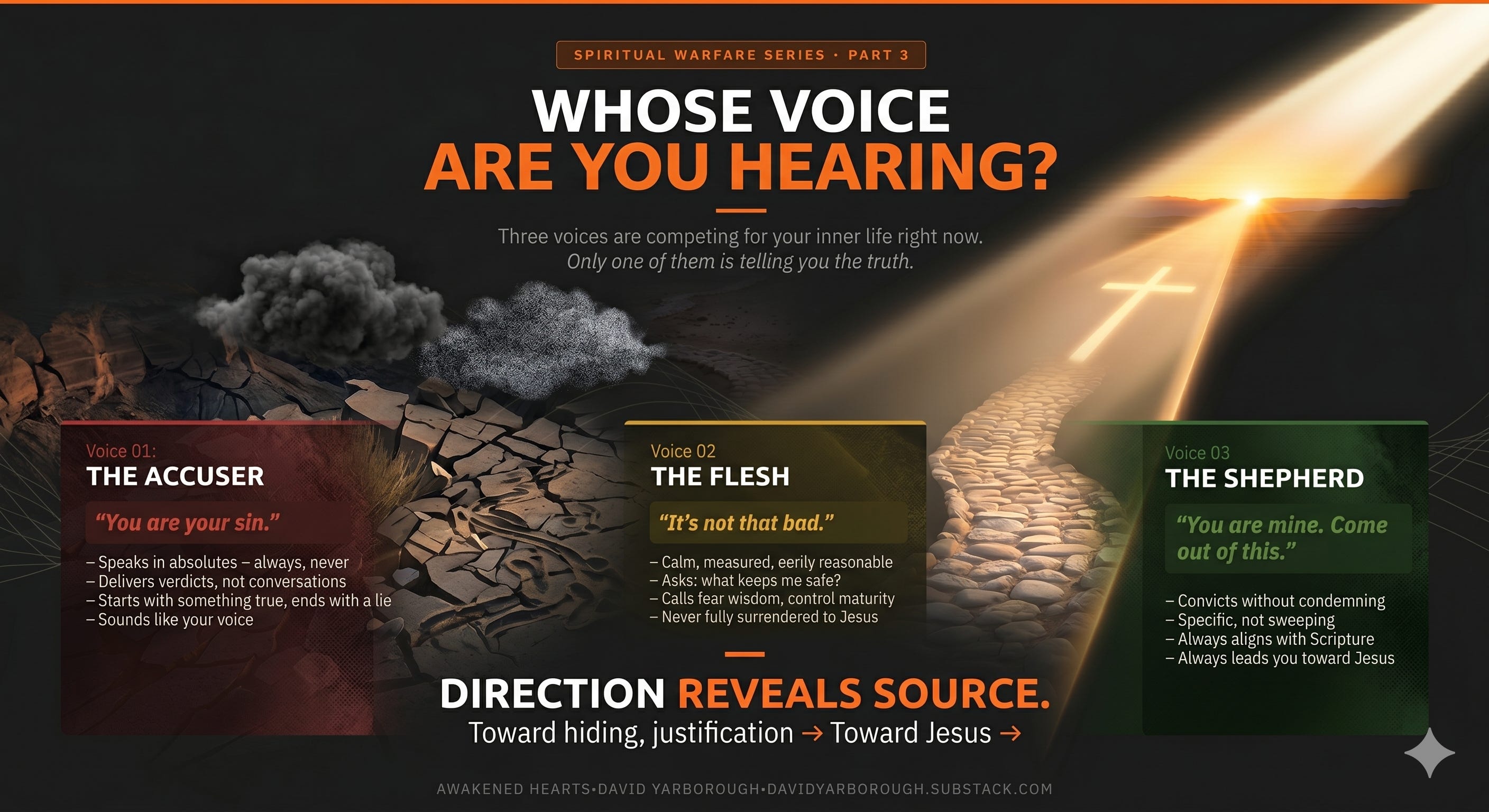
Right now — while you are reading this sentence — there are three voices competing for authority in your inner life.
Three voices. One mind. And only one of them is telling you the truth.
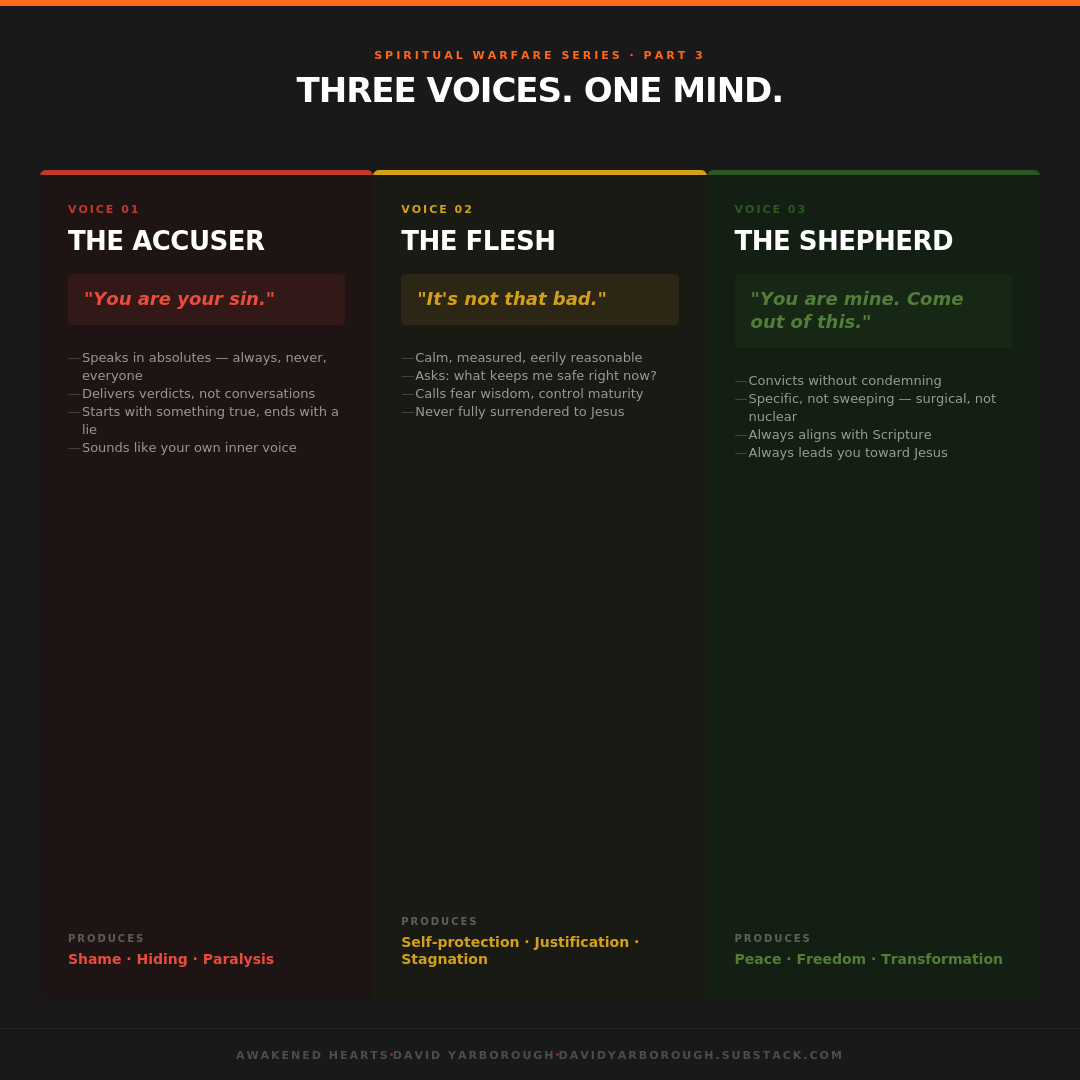
The first voice is the Accuser.
You know this one. You’ve been hearing it your whole life, though you may have been calling it something else. Your conscience. Your gut. Your realistic side. Your inner critic. You’ve given it respectable names because it shows up wearing a respectable face.
But here’s what gives it away. It speaks in absolutes.
Always. Never. Everyone. No one.
It doesn’t have conversations. It delivers verdicts. It doesn’t ask questions — it issues sentences. And it specializes in a very specific kind of cruelty, which is starting with something true.
You failed that person. True. Therefore you are a failure. Lie.
You said something cruel. True. Therefore cruelty is your core, everyone already knows it, and it’s only a matter of time before the people who love you figure it out too. Lie, lie, and more lie.
The true part is the foot in the door. The lie is what walks in behind it and starts hanging pictures.
And the fruit is always the same: shame, hiding, isolation, silence. You get smaller. You pull back. You stop showing up. You go quiet in rooms where you used to have something to say. And somewhere in the second heaven, the enemy marks that as a win.
The second voice is the Flesh.
If the Accuser is harsh, the flesh is calm. Measured. Eerily reasonable. And honestly, a little too comfortable to be trusted.
Protect yourself. You’ve been here before. You’ve earned this. It’s not that big of a deal. Everyone does it. I’m just being realistic.
The flesh is not trying to destroy you. That’s not its style. It’s trying to manage you. It is the part of you that decided, somewhere back in the pain, that self-protection was safer than surrender, that keeping control was better than trusting God, that the walls you built were wisdom rather than fear that learned to dress business casual.
It filters every situation through one question: what keeps me safe right now? Not what is true. Not what is holy. Not what God is actually saying. What is safe. What keeps the wound covered. What keeps you in charge.
And it will make that sound so mature. So measured. So learned-from-experience.
Sometimes it even is. That’s what makes it so hard to discern. The flesh is not always lying. It is just never fully surrendered. And a voice that is not fully surrendered is a voice you cannot fully trust, no matter how reasonable it sounds.
The third voice is the Shepherd.
This is the one most people miss. Not because He isn’t speaking — He is, constantly, patiently, specifically. But because the other two voices are loud and familiar, and your ear has spent years tuning to their frequency. By comparison, the Shepherd can seem quiet. Not because He is weak. Because He is not competing.
His voice is different in every way that matters.
It convicts without condemning. It is honest without being crushing. It is specific rather than sweeping — it doesn’t say you are always this way, it says that thing from last Tuesday. Let’s talk about that. It is surgical where the Accuser is nuclear. It aligns with Scripture, every time, without exception. If the voice in your head is pushing you somewhere the Bible clearly doesn’t go, that voice is not the Shepherd.
And even when what He says is hard — and sometimes it is very hard — there is something underneath it. A settledness. A sense that you are being dealt with honestly by Someone who is entirely, unconditionally, unshakeably for you. He loves you too much to lie to you, and He is strong enough to walk you through whatever He shows you.
Here is the clearest marker of all: His voice always leads you toward Jesus. Every time. Straight to Him. The Accuser pushes you into hiding. The flesh pulls you toward self. The Shepherd walks you directly to the cross.
The Test
Write this down. Put it on your mirror if you have to. Tattoo it somewhere tasteful.
The Accuser says: You are your sin.
The Flesh says: It’s not that bad.
The Shepherd says: You are mine. And I am calling you out of this.

Same failure. Same moment. Same room. Three completely different responses.
One attacks your identity. One excuses your behavior. One redeems both.
So here is the question worth asking every time a heavy thought lands: where is this trying to take me? Because direction reveals source. If the thought is leading you toward hiding, that is the Accuser. If it is leading you toward justification and staying in charge, that is the flesh. If it is leading you — even uncomfortably, even at a cost — toward Jesus, that is the Shepherd.
Follow the direction. It will tell you who sent it.
Let Me Be Direct With You
Some of you have been agreeing with the Accuser for so long you’ve started calling it humility.
Some of you have been following the flesh for so long you’ve started calling it wisdom.
And the voice of Jesus — the one voice in your life that actually leads somewhere worth going — has been getting drowned out by your agreement with the other two.
This is not a minor issue. This is formation. This is discipleship. This is the question of who is actually shaping the way you see yourself, God, and your future. Because you are being formed. Every day, by every voice you agree with, you are being shaped into someone. The only question is who is doing the shaping.
I am not exempt from this. I have pastored people for over two decades and I still catch myself, more often than I would like to admit, agreeing with the Accuser before I even realize it happened. Nodding along with the flesh because it made a compelling case. Missing the Shepherd’s voice because I was too busy and too loud to hear it.
This is not something you graduate from. It is something you practice for the rest of your life.
Start Tonight
Don’t wait. Don’t overcomplicate it. Start with your next thought — and it is coming, probably within the hour.
When it lands, pause. Not long. Just long enough to interrupt the autopilot.
And ask three questions.
Is this making me hide or come alive? Is this drawing me toward Jesus or away from Him? Does this agree with what God says about me in Scripture, or does it quietly contradict it?
Then respond accordingly.
The Accuser? Reject him. Out loud if you have to. That is a lie and I refuse it in the name of Jesus. Not a negotiation. A dismissal. You don’t debate the Accuser — you don’t have to. Jesus already won that argument. You just apply the verdict.
The flesh? Surrender it. I am not the lord of this life. Jesus is. I bring this to the cross. Not suppression. Surrender. There is a difference, and your soul knows it.
The Shepherd? Follow Him. Quickly. Completely. Even when it costs you something — especially when it costs you something.
Most people don’t lose spiritual battles because they lack power.
They lose because they have been listening to the wrong voice for so long they no longer recognize the right one.
But you can retrain your ear. That is the whole project. That is what discipleship actually is — not behavior modification, not rule-following, but learning to hear one voice above all the others and having the courage to follow it wherever it goes.
Jesus said something that still stands:
“My sheep hear my voice.”
Not might. Not occasionally. They hear.
He is speaking.
The question is not whether He’s talking. The question is which voice you’ve been answering to.

Spiritual Warfare Series, Part 3 of 7. Missed the last one? Read “He’s Been Studying You” first.